

A Conversation Companion for Making the Case for Sustainable Packaging and Innovation to Your Organization’s Leadership
With EPR fees reaching into the billions, greenwashing litigation intensifying, and recycled content mandates reshaping supply chains, the financial and legal stakes of packaging have never been higher. This resource is intended to help sustainability professionals, packaging engineers, and others who work on sustainable packaging “make the case” to your organization’s leadership for significant investment in sustainable packaging work and innovation.
Four Forces Shaping the Case for Holistic Sustainable Packaging Strategies




#1 – Compliance Sets the Floor for Sustainability Goals
Sustainable packaging goals haven’t fallen out of favor — they’ve been codified into law. While large brands may seem quieter about voluntary commitments, the reality is that packaging requirements around recyclability in practice, recycled content, and chemical restrictions are now mandated across entire regions. Packaging regulations now span the entire EU, over 98% of the Canadian population, and at least 20% of the U.S. market. Goals for companies haven’t disappeared; they’ve simply moved from the sustainability reports to the statute books.
Here’s where your goals, targets, and timelines have been set for you — or likely will be soon:
While these laws aren’t going away, some implementation timelines and regulatory nuances remain in flux. California illustrates this well: the state’s Producer Responsibility Organization (PRO) Circular Action Alliance has been expected to prepare its EPR program plan and operations even as rulemaking and enforcement expectations fluctuate. This fluidity creates uncertainty as organizations make substantial operational and capital investments despite key details remaining unresolved.
However, this uncertainty also reveals a critical strategic divide. Tomorrow’s most resilient organizations won’t wait for perfect regulatory clarity — they understand that such clarity may never fully arrive. Instead, they will match external uncertainty with internal certainty, committing decisively to compliance with targets as written today and timelines as currently proposed.
Rather than treating regulatory ambiguity as a reason to delay action, resilient organizations can recognize it as an opportunity to build adaptive capacity, develop robust compliance infrastructure, and position themselves as leaders rather than laggards. By acting now with conviction, they transform regulatory uncertainty from liability into competitive advantage.
#2 – Consumers Have their Own Opinions of Sustainable Packaging
Consumers have more opinions about sustainable packaging than many brands may realize.
McKinsey’s 2025 Global Packaging Survey of 11,000 people across 11 countries on four continents revealed recyclability as the top priority when evaluating the sustainability of packaging. Glass and paper ranked in the top three preferred materials in every country surveyed, and metal and beverage cans were the third most preferred material in the United States. Circular attributes – recyclability, recycled content, and reusability – consistently placed in the top four factors for all markets except India.
But do these preferences translate to purchase behavior? It’s complicated. On one hand, ESG-claimed products demonstrate clear market momentum. A 2023 McKinsey-Nielsen study found that products with environmental, social, and governance (ESG) claims saw market growth of 28% over five years, compared to market growth of just 20% for products without such claims. For example, Amazon has seen a 12% sales lift for items with a Climate Pledge Friendly Certification.
Research from 2023 found that U.S. consumers are willing to pay an average premium of 11% for products that have a lower environmental impact. The problem is that the average premium for sustainably marketed products in the U.S. is 26.6%, more than double what consumers want to pay.
Price and quality remain the dominant purchase drivers, with price sensitivity intensifying year-over-year. Environmental concerns rank significantly lower than pricing concerns across categories, though some European markets (like France and Italy) place higher importance on environmental impact.
The reality is that consumers care, but won’t compromise on price, quality, or product appeal. This creates today’s central challenge for the packaging industry: delivering sustainable solutions that match conventional alternatives on cost and performance.
A further complication: Consumer opinions may not align with your environmental data. For example, lightweight, flexible films produce lower lifecycle emissions than rigid plastic packaging, yet consumers can favor heavier formats that they believe to be more recyclable or sustainable. These consumer preferences matter and expecting brands to educate the public on life cycle assessment nuances is unrealistic.
Consumers’ sustainability preferences
Consumers consistently rank materials like glass, paper, and aluminum as their preferred sustainable choice; however, these opinions may not always align with environmental data accounting for impacts like lifecycle emissions.

Glass
Ranked top 3 in surveyed countries

Paper & Cardboard
Ranked top 3 in surveyed countries

Metal & Beverage Cans
Ranked third in the United States
Source: McKinsey, 2025
The way forward requires quickly ushering in a new wave of packaging efficiency. Companies must develop packaging that satisfies consumer expectations around recyclability and sustainability while genuinely reducing environmental impact and maintaining price competitiveness. This will require reevaluating long-standing norms to identify gaps between technological improvements and legacy processes.
This challenge defines the new business imperative for 2026. Sustainable packaging attributes can no longer be treated as a premium add-on or niche market consideration. Rather, sustainability must be engineered at cost parity. As the industry’s goals are re-examined through the lens of EPR programs and recycled content mandates, companies that can solve the cost-compliance-sustainability equation will gain decisive competitive advantage.
The organizations that succeed won’t rely on greenwashed claims or ignore consumer expectations. They’ll innovate toward packaging that’s simultaneously recyclable, compliant, affordable, and operationally viable at scale.
Sample Conversations
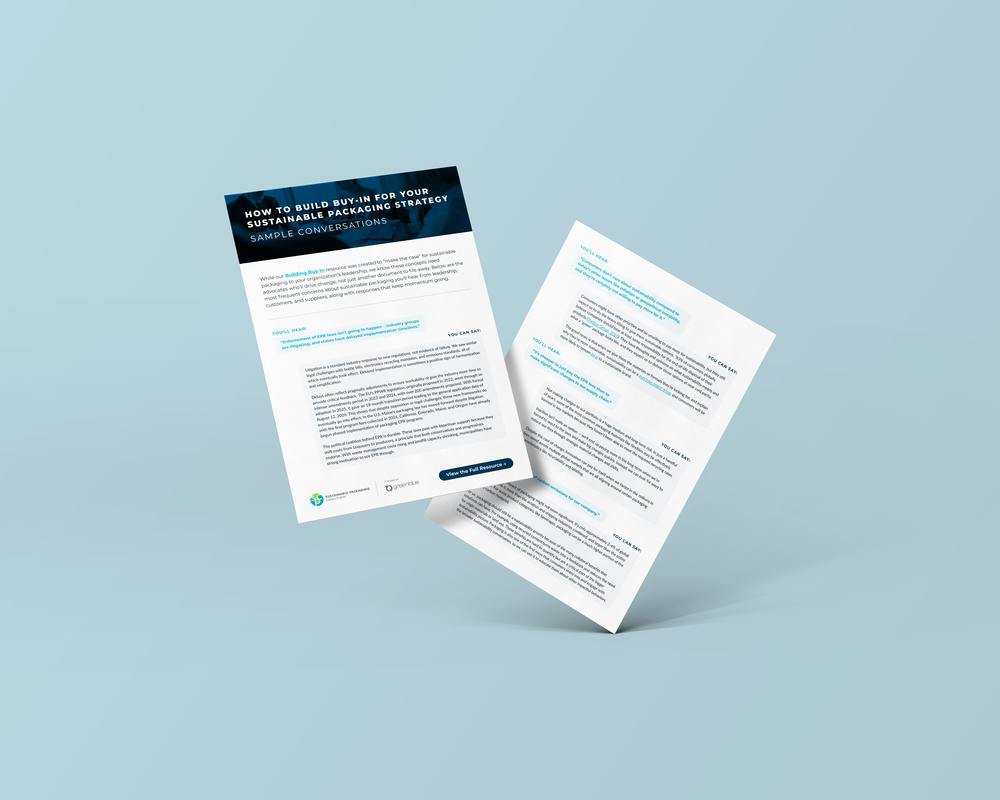
Want to “make the case” for sustainable packaging to your organization’s leadership?
Use our sample conversations to address common concerns and connect sustainable packaging to your leadership’s priorities.
Download the Sample ConversationsApril 2026, Updated June 2026
Olga Kachook, Director, Sustainable Packaging Coalition
Paul Nowak, Executive Director, GreenBlue
Mary Katherine Moore, Sr. Manager, Marketing & Communications, GreenBlue
About SPC
The Sustainable Packaging Coalition (SPC), a trademark project of GreenBlue, is a membership-based collaborative that believes in the power of industry to make packaging more sustainable. As the leading voice on sustainable packaging, our mission is to catalyze actionable improvements to packaging systems while lending an authoritative voice on packaging sustainability challenges.